Spring 2027 Nonmajor Course Offerings

Whether you're studying engineering, business, science, or the humanities, the arts can expand how you think, communicate, and engage with others. Taking a performing arts course offers opportunities to develop creativity, confidence, and cultural awareness while completing your Pathways requirements. Explore the School of Performing Arts courses below to find a class that fits your interests and degree plan.
CINE 2054: Introduction to Cinema
Introduction to cinema as a medium for artistic communication. Interpretation and analysis of films to understand designs, ideas and values in artistic and cultural contexts. Basic elements of cinema structure and cinema terminology, phases of cinema production, cinema style of individual directors, creative work of cinematography, production design, and editing, ideological and social meaning in cinema, demographics of visual representation, cinemas economic marketplace. Ethical values and conflicts as found in given films, and ethical reasoning as part of the analysis of cinema.
Pathway Concept Area(s): 2 Critical Thinking Humanities
CINE 2144: Topics Exploring Cinema Studies - Football and Cinema
Examination of motion pictures and related media as expressive forms that shape and reflect human experience. Course topics vary by semester and may include themes such as sports and cinema, identity and representation, or media and technology. Students apply introductory concepts and methods of film and media analysis to specific case studies and interpret visual storytelling through aesthetic, cultural, critical, theoretical, and ethical perspectives. They also communicate informed, evidence-based arguments about cinema through writing and discussion. Designed for students across disciplines seeking a topics-based introduction to cinema as a humanistic field of study. May be repeated 2 times with different content for a maximum of 9 credit hours. Through iconic football films and related media, "Football and Cinema" explores how the game comes to life on screen and how cinematic storytelling shapes ideas about sport, identity, community, and culture. Students develop foundational skills in visual literacy and media criticism, with no prior background in cinema studies or production required.
Pathway Concept Area(s): 2 Critical Thinking Humanities
CINE 2144: Topics Exploring Cinema Studies - Photography and Cinema
Examination of motion pictures and related media as expressive forms that shape and reflect human experience. Course topics vary by semester and may include themes such as sports and cinema, identity and representation, or media and technology. Students apply introductory concepts and methods of film and media analysis to specific case studies and interpret visual storytelling through aesthetic, cultural, critical, theoretical, and ethical perspectives. They also communicate informed, evidence-based arguments about cinema through writing and discussion. Designed for students across disciplines seeking a topics-based introduction to cinema as a humanistic field of study. May be repeated 2 times with different content for a maximum of 9 credit hours.
Pathway Concept Area(s): 2 Critical Thinking Humanities
CINE 4154: Quantitative Research Methods in Cinema Studies
This course introduces students to the application of quantitative thinking to the study of cinema. Through hands-on research and analysis, students will learn to frame questions, design solutions, and interpret data related to filmmaking practices and audience behaviors. Students will learn about various research paradigms, and how to choose methodologies based on what questions they would like to answer. Emphasis is placed on applying foundational quantitative principles to use various sampling techniques to gather data, evaluate evidence, draw valid inferences, and critically assess conclusions about media practices and effects. Students will also explore the challenges of studying human behavior within diverse historical and cultural contexts, developing skills to navigate uncertainty while producing meaningful insights.
Prerequisite(s): STAT 1014 or STAT 2004
Pathway Concept Area(s): 5A Quant and Comp Thnk Adv.
MUS 1005: Theory Fundamentals
Fundamental elements of music theory. 1005: Introduction to elements of music theory. Musical notation, scales of various global traditions, foundations of tonality; intervals, triads, dominant seventh chords, rhythm, meter, cadences, harmonic analysis. Composition with species counterpoint and the twelve-bar blues progression. Aural recognition of musical sounds through ear training. 1006: More complex harmonic and rhythmic processes. Increase complexity of intervals, chords, rhythms, progressions and score reading. Introduce transposition and vocabulary for timbre and textural discussion. Aural recognition of more advanced musical sounds through ear training. Fluency in terms and conventions for western art music, rock, hip-hop. Composition of original music.
Pathway Concept Area(s): 6A Critique and Practice in Arts, 6D Critique and Practice in Design
MUS 1104: Music Appreciation
Survey of the art of music encompassing a variety of music styles and historical eras in both the western and non- western world. Students will develop strategies to contextualize music, via listening, from the perspective of the listener, composer, and performer.
Pathway Concept Area(s): 6A Critique and Practice in Arts
MUS 1144: South Asian Music Traditions
Examine popular music in cultural, political, and historical perspectives. Introduction to the study of music and its cultural contexts. Technical analysis of music and critical engagement with sociohistorical concepts. Development of listening and writing skills. Course may be repeated once for a maximum of 6 credit hours.
Pathway Concept Area(s): 6A Critique and Practice in Arts
MUS 1154: Discover Your Voice
Vocal class for non-music majors, no previous musical experience or audition needed. Develop tools, body awareness, and a daily routine for healthy singing, using your natural speaking voice. Interpret multiple viewpoints of songwriters and learn to communicate the poetry of their music effectively. Analyze songs more deeply from the inside out using the basic building blocks of music theory. Grow more confident to share your voice through music. Reflect on your gradual journey as a developing singer, and how connecting with music impacts your life, mental health, and relationships with others.
Pathway Concept Area(s): 6A Critique and Practice in Arts
MUS 1164: Movie Music
Introduction and survey of movie music and its role in narrative film across historical, cultural, and artistic contexts. Students will identify key figures and trends, analyze musical elements and film cues, and evaluate the role of music in cinematic storytelling. Students develop listening and writing skills through engagement with full-length films, film scenes, and their scores.
Pathway Concept Area(s): 6A Critique and Practice in Arts
MUS 1294: Guitar 101
Group instruction for beginning and early-stage guitar students focusing on the development of foundational technique, music reading, and chord vocabulary. Develop understanding of a range of beginner-level repertoire and strumming patterns across multiple styles. Emphasis on building functional playing ability, rhythmic accuracy, and ensemble awareness in a collaborative classroom setting. Strengthen musical confidence through guided practice, peer interaction, and skill-based exercises.
Pathway Concept Area(s): 6A Critique and Practice in Arts
MUS 2014: AI in Music
Introductory course covers ethical, theoretical, and practical aspects of AI in music. Covers the mechanics of AI and Machine Learning, and the (co-)creation and production of music-centric artifacts using AI tools.
Pathway Concept Area(s): 5F Quant and Comp Thnk Found., 6A Critique and Practice in Arts
MUS 2116: Survey of Western Music
Survey and study of the historical evolution of Western art music. Classical and other music from the Romantic era through the 20th century to music of today. Investigation of the materials oMUS f music. Exploration of music as it both reflects and impacts history, including historical considerations of gender, race, culture, and other extramusical factors. Relevance of historical and contemporary music to our society today.
Pathway Concept Area(s): 2 Critical Thinking Humanities, 6A Critique and Practice in Arts
MUS 2134: Disability Culture and the Arts
Disability as an identity, community, and culture through a study of music and the arts. Overview of the disability rights and disability justice movements in the United States, as told through music, film, literature, and performance art. Analyze creative works, confront obstacles to inclusion, and discover disability cultural values. No previous musical training required.
Pathway Concept Area(s): 6A Critique and Practice in Arts, 7 Identity and Equity in U.S.
MUS 2144: Music and Video Games
Introduction to the study of music, games, and audiovisual media and relevant analytical concepts. Intersection of music and video games from historical, aesthetic, and social perspectives. Analysis of video games from musical and ludic perspectives. Development of listening and writing skills.
Pathway Concept Area(s): 6A Critique and Practice in Arts
MUS 3064: Digital Sound Manipulation
Cross-disciplinary study of recording technology and its effects on music. Aesthetics of electronic music. Recording and editing digital sound. Visual programming for live sound synthesis and processing. Acoustic compilers for programmatic sound processing and synthesis. Individual creative applications of tools learned in class. Team-based work on creative projects. Emphasis on intercultural and global use of creative music technologies.
Pathway Concept Area(s): 6A Critique and Practice in Arts
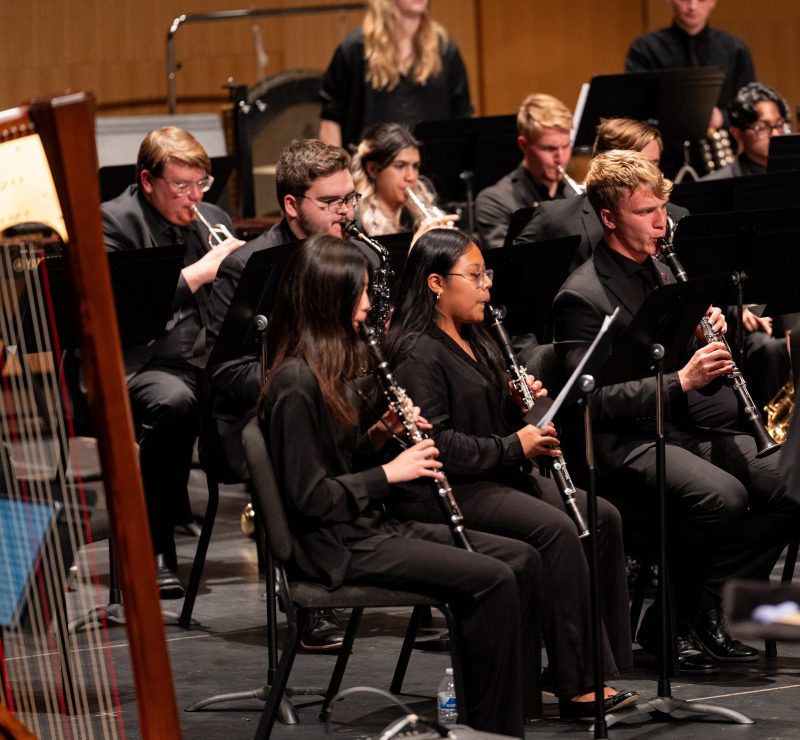
MUS 3314: Instrumental Ensembles
Instruction and participation in instrumental music performance ensembles under direction of members of the music faculty. Attention to technical proficiency, stylistic elements, musical design and interpretation in the works to be performed. Addresses ethical obligations and practice in a music ensemble setting. May be repeated for a combined maximum of 8 hours. Consent and audition required.
Pathway Concept Area(s): 6A Critique and Practice in Arts
MUS 3414: Choral Ensemble Music
Instruction and participation in choral music performance ensembles under direction of members of the music faculty. Attention to technical proficiency, stylistic elements, musical design and interpretation in the works to be performed. Addresses ethical obligations and practice in a music ensemble setting. May be repeated for a combined maximum of 8 hours. Consent and audition required.
Pathway Concept Area(s): 6A Critique and Practice in Arts
MUS 3814: Jazz History
A survey and analysis of jazz music, including traditional jazz, big band, bebop, rhythm and blues, free jazz/avant garde, fusion, and hip-hop. Exploration of historical, social, and cultural forces and trends that influence the creation and interpretation of jazz music.
Pathway Concept Area(s): 6A Critique and Practice in Arts
The Key Benefits for Non-Majors Are:
Overcoming Public Speaking Anxiety: Acting exercises and warm-up games—such as working with simple texts or improv—teach you how to project your voice, control your body language, and manage stage fright in a low-pressure environment.
Developing Empathy and Perspective: Stepping into a character requires you to research, personalize, and understand motivations outside of your own life experience, which deepens emotional intelligence.
Boosting Adaptability and Communication: Improv and scene work train you to listen actively, stay present in the moment, and react authentically when plans or scripts change.
Breaking Social Pressures: Classroom exercises push you past personal self-consciousness, helping you build resilience and social confidence that translate into job interviews, presentations, and everyday relationships.
Creativity and Collaboration: Working with other students in these hands-on experiential classes creates bonds of people working together for creative fulfillment.
TA 2024: Introduction to Acting
Introductory performance class in acting skills and theories as a participant (actor) and observer (audience) for the non-major. Includes performances of dramatic literature/ improvisation for live audience, creating character biography and script analysis, historical and intercultural contexts, and techniques in constructive criticism that incorporate interpretive strategies.
Pathway Concept Area(s): 2 Critical Thinking Humanities, 6A Critique and Practice in Arts
TA 2404: Creative Collaboration
Introduction to principles of collaboration. Practice situational, intrapersonal, and interpersonal awareness; audience engagement and comprehension; effective feedback skills using primary and secondary communicative actions; addressing perceptual differences within collaborative and cross‑cultural relationships; effective storytelling; and team creativity. Employ dramatic role play, conflict resolution techniques, and applied theatre techniques to communicate across differences in public and professional settings.
Pathway Concept Area(s): 1A Discourse Advanced, 6A Critique and Practice in Arts, 6D Critique and Practice in Design
DANC 2004: Anatomy for Performers
An experiential course merging the artistic, experiential, and conceptual understanding of the human body, and how all of its elements work together to produce motion and the sense of being. Study of the anatomical structures of the body through an experiential lens of motion and sensory perception. Introduction of the concepts of kinesiology through the study of bone, joint, tissue, muscular, and organ structures. Emphasis on holistic perspectives of the body through active listening, ethical reasoning, healthy self-image, and attention to practices of equitable embodied identity. Lecture, demonstration, and experience-based partnering work that draw from a variety of somatic traditions including yoga, pilates, Body-Mind Centering, release technique, Alexander and Feldenkrais techniques, Gyrotonic/Gyrokinesis, and mediation. Designed for performers in the arts, athletes, martial artists, or any students wishing to study the body from an experiential lens.
Pathway Concept Area(s): 6A Critique and Practice in Arts, 7 Identity and Equity in U.S.
DANC 2014: Introduction to Dance History
Survey of dance history as an art form with global scope. Language of dance criticism and dance writing practices. International dance forms and the emergence and development of 20th and 21st century modern and post-modern concert dance in the United States from the confluence of European folk and court dances, ballet, African and Caribbean influences, and other American cultural dynamics. Emphasis on ethical and aesthetic modes of viewing dance performance with attention to issues of gender and sexuality, race and ethnicity, ability, class, and identity.
Pathway Concept Area(s): 6A Critique and Practice in Arts, 7 Identity and Equity in U.S.
DANC 2024: Introduction to Dance Techniques
Beginner-level studio dance course. Introduction of movement techniques, improvisation/composition, performance, experiential anatomy, and an overview to concepts in dance history. Development of flexibility, strength, coordination, rhythm, and vocabulary in the modern idiom. Concepts of time, space, energy, and choreographic form presented through set movement exercises, improvisation, and a final compositional project. Training in a variety of movement vocabularies including modern/contemporary, ballet, and cultural dance forms. May be repeated once with different content for a maximum of 6 credits. Design Lab/Studio.
Pathway Concept Area(s): 6A Critique and Practice in Arts
DANC 2104: Moving Body, Moving Mind
Methods of working intentionally towards cultivating optimal brain states. Mind/body practices to develop connections between contemporary neuroscience, movement, and meditative practices. Studies in the intersection of consciousness, movement, and thought. Introduction to yoga, meditation, authentic movement, experiential anatomy, and somatic work. Emphasis on holistic perspectives of the body through active listening, ethical reasoning, healthy self-image, and attention to the practices of intentional embodiment.
Pathway Concept Area(s): 6A Critique and Practice in Arts
DANC 3024: Intermediate/Advanced Dance Techniques
Intermediate/advanced level course in movement techniques. Training in a variety of movement vocabularies including modern/contemporary, ballet, and cultural dance forms. Improvisation/composition, performance, concepts in anatomy/kinesiology, and 21st century contemporary dance forms. Development of flexibility, strength, coordination, rhythm, vocabulary in the modern idiom, and focused study of partnering concepts from a variety of hybrid forms. Concepts of time, space, energy, and choreographic form presented through set movement exercises and two compositional projects. May be repeated 3 times with different content for a maximum of 9 credits. Design/Lab Studio.
Prerequisite(s): DANC 2024
Pathway Concept Area(s): 6A Critique and Practice in Arts